
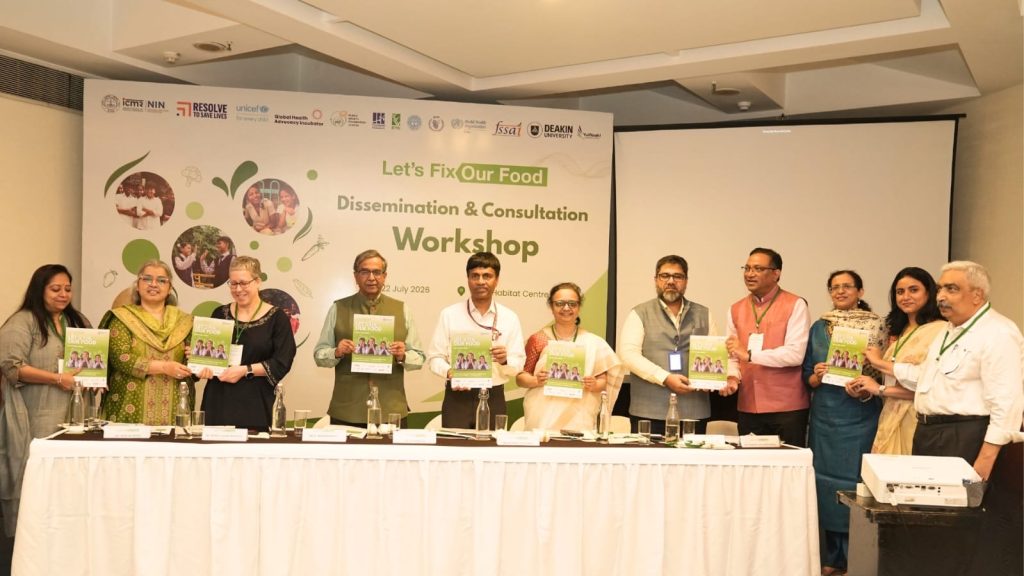
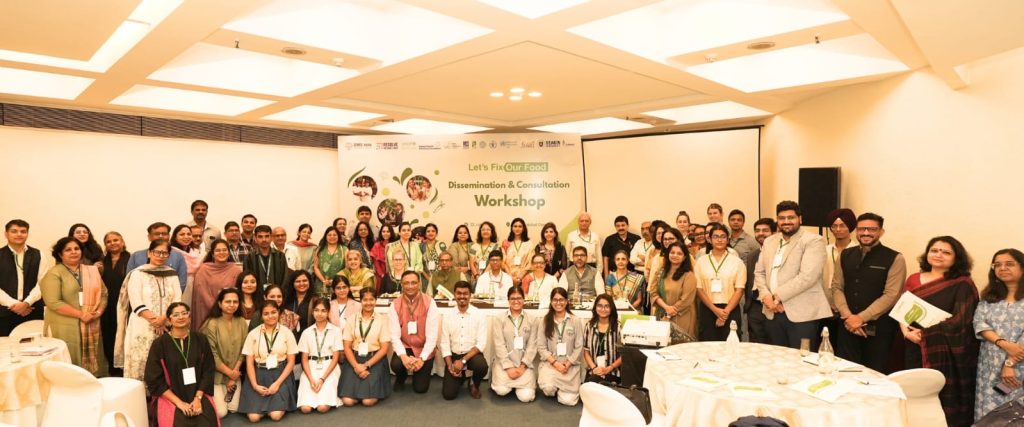
The Let’s Fix Our Food (LFOF) Consortium, led by the Indian Council of Medical Research–National Institute of Nutrition (ICMR-NIN), today released ‘Priority Policy Actions to Promote Healthier Diets and Food Environments for Children and Adolescents in India’, presenting a roadmap for creating healthier food environments and improving dietary behaviours among India’s children and adolescents.
The policy document was formally launched by Dr. M. Srinivas, Member (Health), NITI Aayog, during the LFOF Dissemination and Consultation Workshop held at the India Habitat Centre, New Delhi, in the presence of Dr. Bharati Kulkarni, Director, ICMR–National Institute of Nutrition (ICMR-NIN), Prof. (Dr.) K. Srinath Reddy, Founder President, Public Health Foundation of India (PHFI), senior representatives from the Ministry of Health and Family Welfare, Food Safety and Standards Authority of India (FSSAI), UNICEF India, Resolve to Save Lives (RTSL) and other consortium partner institutions, researchers, development partners and youth representatives.
The Let’s Fix Our Food Consortium is a multi-institutional national platform established to generate evidence and catalyse policy action for healthier food environments in India. Led by ICMR-NIN, the Consortium brings together Resolve to Save Lives (RTSL) India, UNICEF India, Global Health Advocacy Incubator (GHAI), Public Health Foundation of India (PHFI), World Health Organization (WHO), Food Safety and Standards Authority of India (FSSAI), Institute of Economic Growth (IEG), World Food Programme (WFP), Lady Irwin College, International Food Policy Research Institute (IFPRI), Deakin University and several other national and international partners. Through collaborative research, policy analysis, advocacy and stakeholder engagement, the Consortium seeks to support India’s efforts to prevent diet-related non-communicable diseases by transforming food environments, particularly for children and adolescents.
The publication synthesizes nearly three years of multidisciplinary research, stakeholder consultations and policy dialogues undertaken by the Consortium and presents evidence-informed policy recommendations across key domains, including healthy school food environments, nutrition literacy, front-of-pack nutrition labelling, regulation of marketing of unhealthy food to children, taxation of foods high in fat, salt and sugar (HFSS), healthier dietary fats, salt reduction, low-sodium salt substitutes, social and behaviour change communication, youth engagement, and fiscal measures to promote healthier diets.
Speaking on the occasion, Dr. M. Srinivas, Member, NITI Aayog said, “the importance of evidence-based, multisectoral policy action to create healthier food environments for children and adolescents, collaborative initiatives such as the Let’s Fix Our Food Consortium are essential for addressing the growing burden of overweight, obesity and diet-related non-communicable diseases in India”.
Welcoming the participants, Dr. Bharati Kulkarni said, “ICMR-NIN is committed to generating high-quality evidence and fostering partnerships that translate research into public health action. Policy recommendations represent the collective efforts of researchers, policymakers, development partners and young people working towards healthier food environments for India’s future generations”.
Prof. (Dr.) K. Srinath Reddy underscored the need for comprehensive policy interventions that address the commercial, social and environmental determinants of unhealthy diets and called for sustained action to protect children and adolescents from obesogenic food environments.
The workshop also witnessed the launch of several knowledge products developed under the Let’s Fix Our Food Consortium, including the LFOF website, the Nutrition Environment Assessment Toolkit for Schools (NEAT-S) and its report, an e-learning module on understanding food labels, and a suite of ICMR-NIN educational resources on fats, sugars and salt to strengthen nutrition literacy among children and adolescents.
Marie-Claude Desilets, Chief of Nutrition, UNICEF India emphasized “Malnutrition is no longer only about undernutrition. Rising obesity, driven by unhealthy diets, challenges healthy growth among children and adolescents. The release of these ten policy briefs and the Nutrition Environment Assessment Toolkit for Schools (NEAT-S) mark a step towards creating policies for healthier school food environments. Every child has the right to grow up in a food environment that enables them to thrive, learn and achieve their full potential.”
Dr. Syed Imran Farooq, Executive Director, Resolve to Save Lives (RTSL), highlighted the need to reduce excess salt, fat and sugar intakes alongside food policies that support healthier food environments and lower the burden of cardiovascular diseasesand other health threats. He recognized the ICMR-NIN-led consortium’s leadership and reaffirmed RTSL’s commitment to the shared vision of healthier food environments across India.
The consultation showcased new evidence generated by consortium partners on school food environments, unhealthy food marketing, nutrition education, dietary behaviours, fiscal policy options, and nutrition environment assessments across multiple states. The workshop concluded with thematic discussions on translating the evidence into actionable policy recommendations to support healthier food environments for children and adolescents.